
Internet Gig-work: India’s Fastest Growing Job Category


At a Glance:
- India’s gig internet workforce has grown from ~1 Mn to ~6 Mn, and is projected to reach 17-21 Mn by 2030
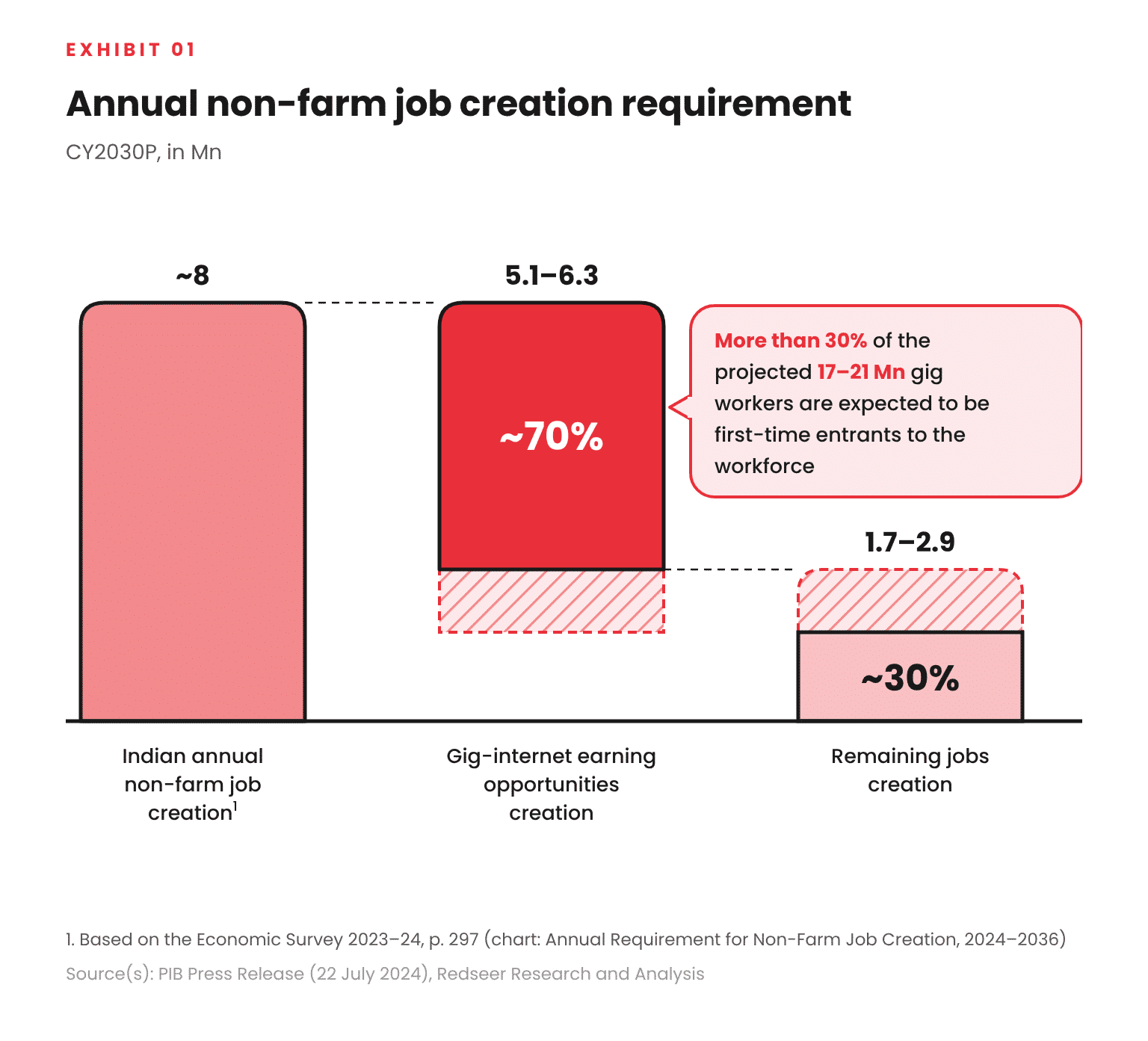
- Gig internet platforms could account for ~5.1-6.3 Mn of India’s ~8 Mn annual non-farm job requirement by 2030
- ~54% of gig workers had no paid work of any kind before joining. This is a workforce reaching people the formal economy hasn’t been able to reach
Six years ago, a few lakh people, mostly in the metros, were picking up orders and ferrying strangers across town through an app. Call it a side hustle or a stopgap; there wasn’t a name for it yet. About a million Indians were active on gig platforms each month.
Today that number is around 6 million. Roughly 3.4 million drive for ride-hailing apps and 2.4 million deliver, with a smaller but growing group doing home services. The work has also moved out of the metros, and you now find it in smaller cities too.
By 2030, Redseer estimates, 17 to 21 Mn Indians, i.e. 3% of the country’s workforce could be working the gig-way.
But the growth is only half the story. What matters is what it’s being measured against.
About 70% of India’s annual non-farm jobs gap could be met by gig platforms”
India needs to create roughly 8 million non-farm jobs annually to absorb its growing working-age population by 2030. Given the rapid proliferation of gig work over the last six years, could the sector offer a way to bridge this employment gap?
The numbers suggest it could. Gig platforms could account for 5.1–6.3 million of the annual job requirements. Beyond this, the sector is projected to bring 21 million first-time entrants to the workforce, including people who may otherwise have remained outside the formal job market.
Redseer’s survey findings reveal that 54% of gig workers surveyed said they had no form of paid employment before taking up gig work. This challenges the narrative that the gig economy simply repackaged existing labour, shifting workers from traditional sectors into platform-based roles. Instead, it points to a more significant shift: gig work is bringing previously untapped segments of the population into the paid workforce.
Easy entry fuels the growth, but the forecast rests on ride-hailing
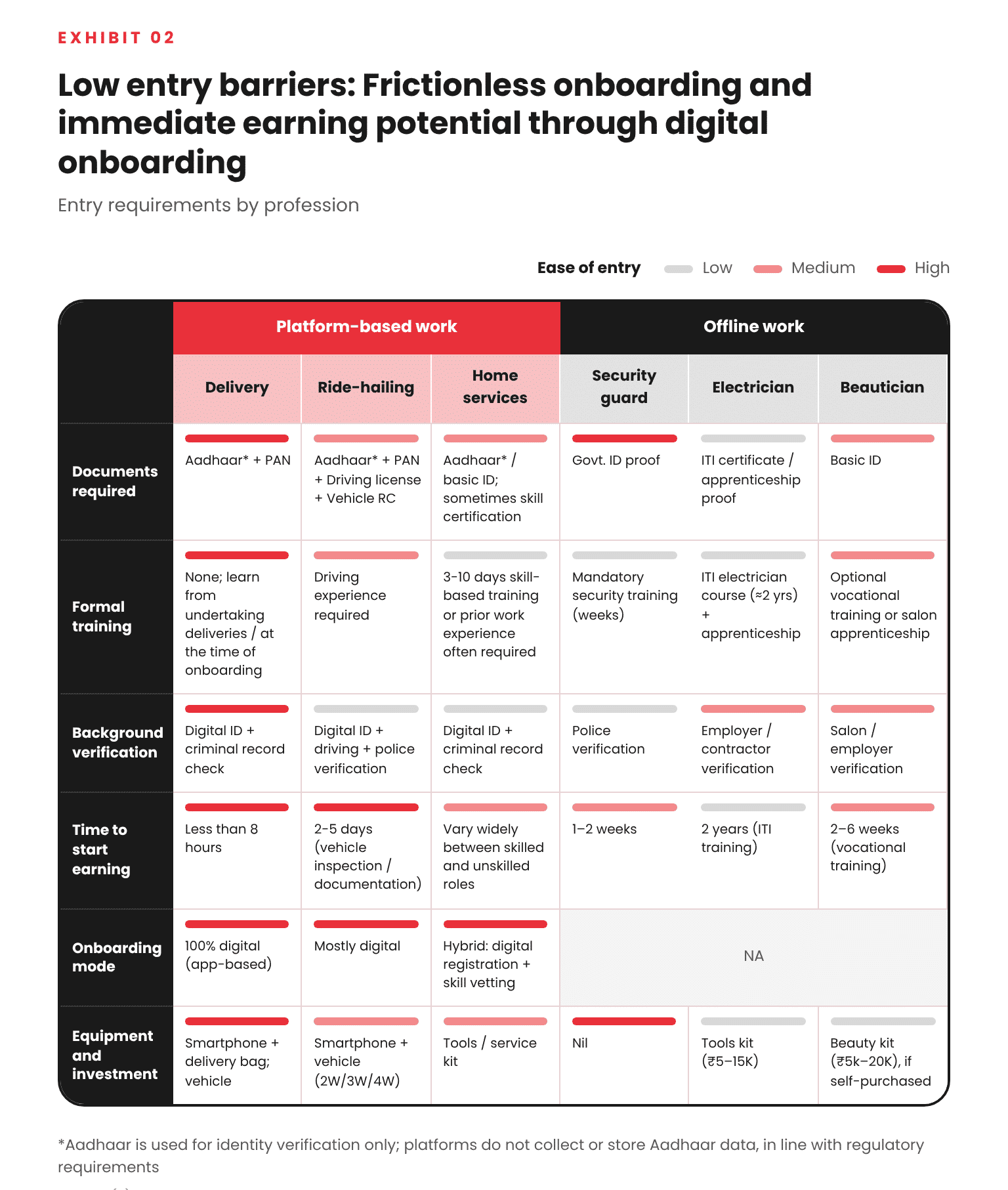
Entry into the gig workforce has a relatively low barrier. Compared to traditional forms of employment, getting started with gig work is straightforward: the primary requirements for delivery roles are an Aadhaar and PAN card. With these documents in place, an individual can go from downloading an app to earning their first rupee in less than eight hours, without undergoing any formal training.
Redseer believes growth within gig work will not be even across segments. Ride-hailing is projected to carry the bulk of it, growing from 3.4 Mn to 12-14 Mn by 2030, by a wide margin the most aggressive assumption in the entire forecast. If that sector underperforms, the whole 17-21 Mn range moves with it.
In terms of gender, female participation ranks low, with only 1% of this workforce comprising of women gainst roughly 28% of India’s overall workforce. That gap isn’t a rounding error; it’s the largest single pool of untapped supply the sector has, and one it has barely touched so far.
Even then, gig work is part of the answer to the jobs gap and cannot be all of it
While gig work can absorb a meaningful share of the employment gap in India, it cannot be the entire job creation strategy. Suggesting otherwise would imply that the push to create formal, long-term employment should take a back seat, which is neither realistic nor desirable.
This distinction is critical. The finding that 54% of surveyed gig workers had no prior paid employment points to the sector’s ability to reach a segment of the workforce that the formal economy had yet to absorb. This is distinct from the ~30% first-time entrant figure, which speaks to a separate, future employment opportunity.
Therefore, gig work should be recognised for what it is: a significant contributor to the country’s employment needs, not a replacement for the effort to create jobs. Treating gig work as the solution to the entire employment challenge would underestimate the scale of the problem and, just as importantly, overlook the specific role it is already playing in addressing it.
Written by



Redseer Gig Internet Workforce Report: 2026

India Online Retail 2026: The Fastest Year in Five, and the New Engines Behind It

Value Grocery Commerce: The Bharat Unlock

The Gaming and Interactive Media Opportunity in India

Gig Work is Bridging India’s Job Gap and Lifting Earnings

Skilling and Employability Solutions for the Next Half Billion

How AI-led Hiring Is Reshaping India’s Office Market

How Quick Commerce Can Win Bharat

The New Rules of Growth in India’s $150 Bn Packaged F&B Market

Two Engines, One Basket: How Quick & Value Commerce are Rewriting India’s Retail Story

Quick-Com, Value Commerce and GenZ Drive India’s Online Retail Growth in 2026

Online Retail Heads for USD 90 Bn+ in 2026, Its Fastest Growth in Five Years
Redseer Gig Internet Workforce Report: 2026
India Online Retail 2026: The Fastest Year in Five, and the New Engines Behind It
Value Grocery Commerce: The Bharat Unlock
The Gaming and Interactive Media Opportunity in India
Gig Work is Bridging India’s Job Gap and Lifting Earnings
Skilling and Employability Solutions for the Next Half Billion