The Guide to Launching an Online Retail Brand in MENA


Access is no longer the hard part. Online has opened the shelf to brands of every size to build a lead while the field is open. But the window to do that is short. –Akshay Jayaprakasan, Associate Partner, Redseer Middle East
When you walk into a supermarket in Dubai, you’ll see the leading brands dominating most category shelves. A challenger brand might find a few product facings, likely on the top or bottom shelves. But on online platforms, the playing field looks different. Every brand gets a spot on the screen, separated by little more than a thumb’s width. For new brands in the MENA region, this democratization is a big opportunity.
The online grocery market in the UAE, KSA, and Egypt grew from $3.7 billion to $6 billion between 2023 and 2025, at a 27% CAGR. Quick commerce is taking a bigger share of this pie in these regions. Counting by the app where the order was placed, Quick Commerce GMV within online grocery grew from 13-30% in 2021 to 66-72% in 2025.
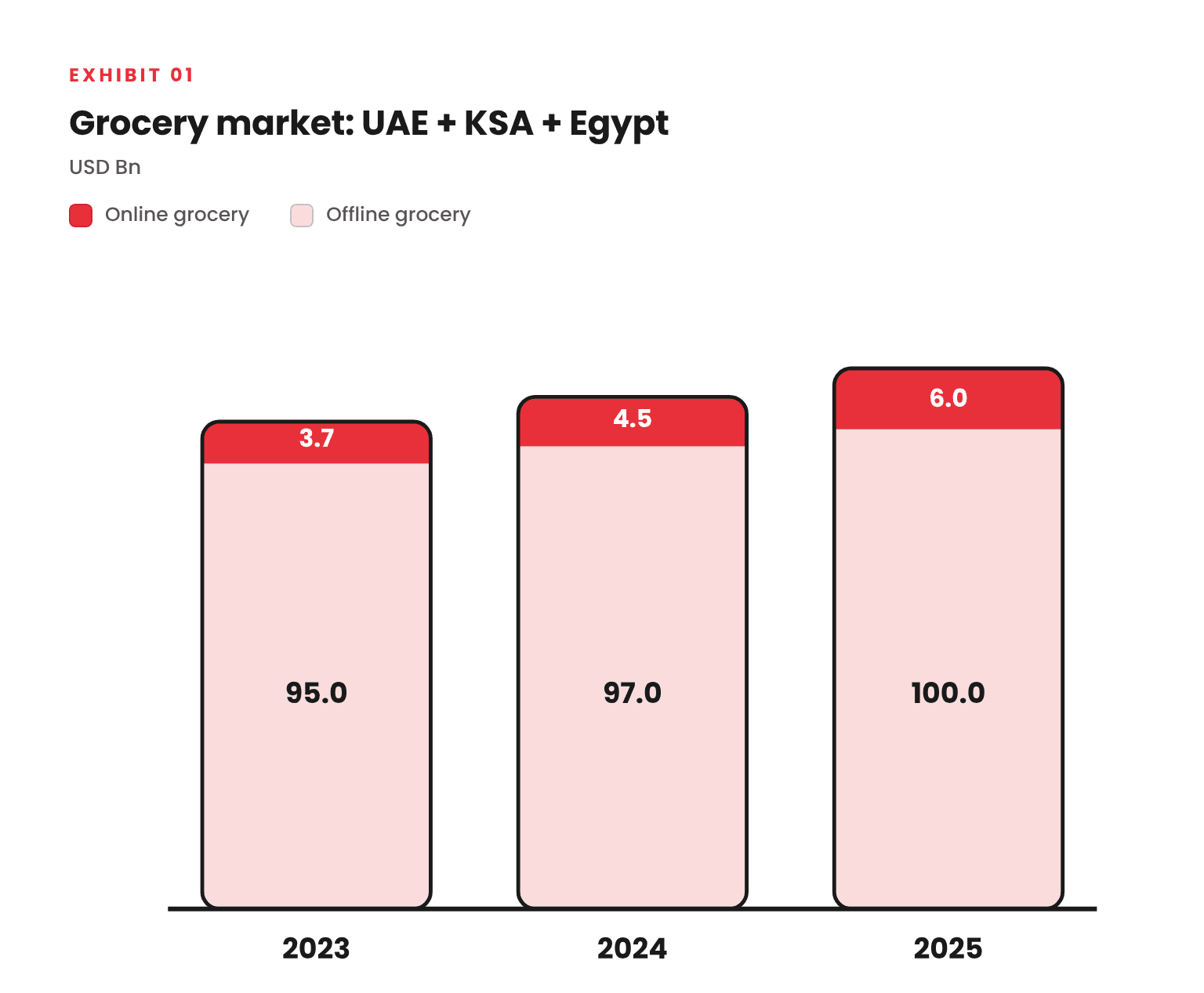
This growth phase in the online grocery market means new brands have easier access to consumers and more room to compete with established players.
However, the window to gain meaningful advantage from this opportunity, without outstripping your budget, is short. In the next phase, platforms will price convenience, so listing and promotion costs for brands will escalate. As of now, only a handful of brands are utilizing the full potential of this promising online shelf.
We examine what brands need to do now to emerge as leading players in the MENA grocery market.
1. Treat online launches as your proving ground
When you launch online, treat the first listing as research as much as a sale. Launch in one city at a time, on one platform, and read sell-out by SKU and by pack every week. Here’s what the data can show:
- Rate of sale – how fast a product moves,
- Repeat purchase – whether shoppers return,
- Testing across a price ladder – what they will pay.
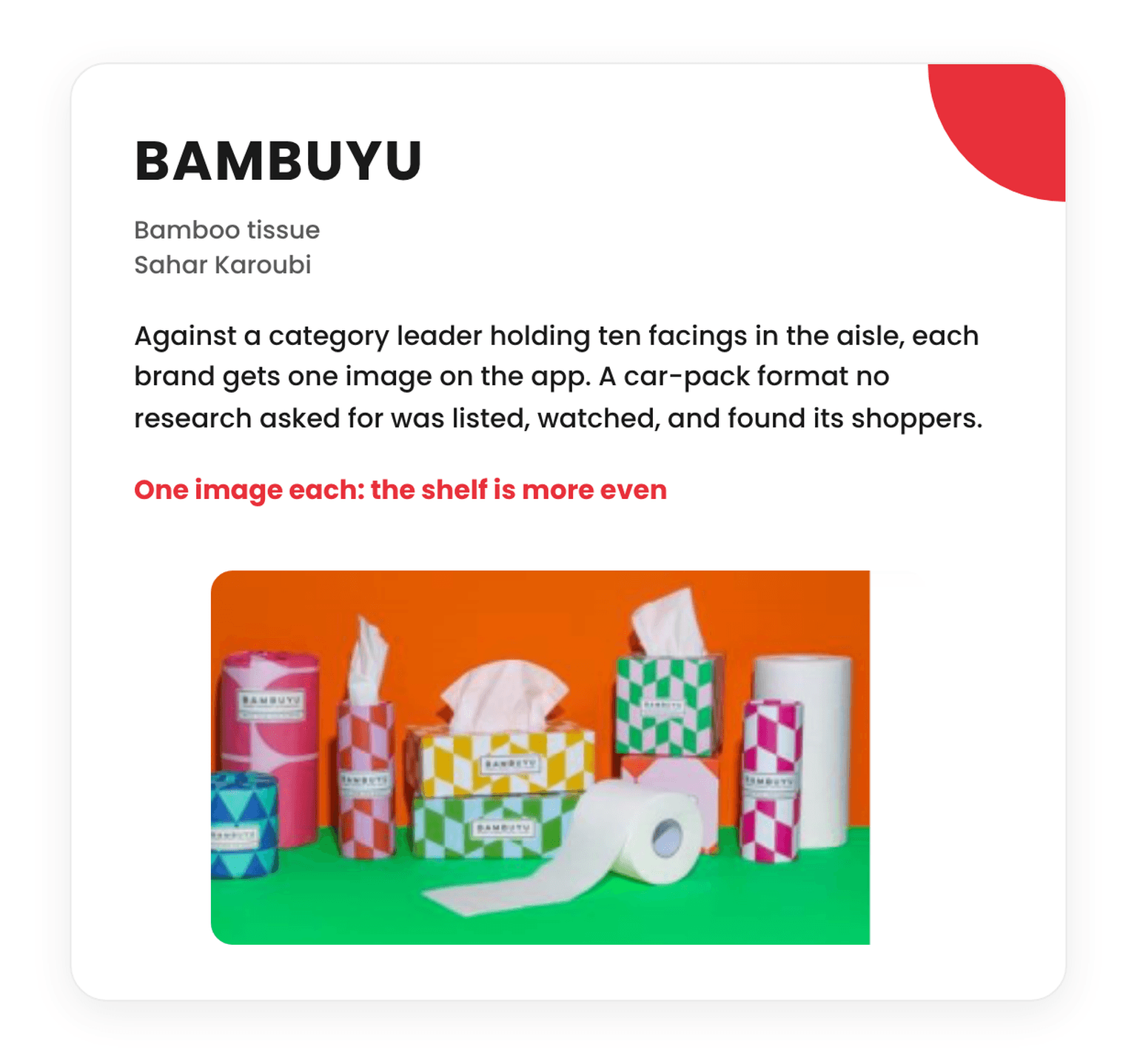
Bambuyu, the bamboo tissue brand, shows how listings can be used as a test. The brand listed a car-pack format nobody had validated beforehand, watched the numbers and found its shoppers.
On an app, you get a first read within weeks, and you can scale or drop a product within days. In traditional retail, a national listing can take six to twelve months to answer the same question.
2. Manage the digital shelf vigorously
What packaging does in a store, the product page does on an app. Get the basics in place first, because they give a young brand its highest returns:
- Hero and secondary images,
- English and Arabic copy
- Ingredients
- Category placement
- Price accuracy.
Gramiyaa’s cold-pressed oils show why. The design was strong, but the pack did not read as cooking oil, so the problem was comprehension, not product. Our analysis shows that this gap in comprehension is what kills most brands in the first year. For Gramiyaa, a week of new imagery, clearer copy and corrected category mapping fixed it.
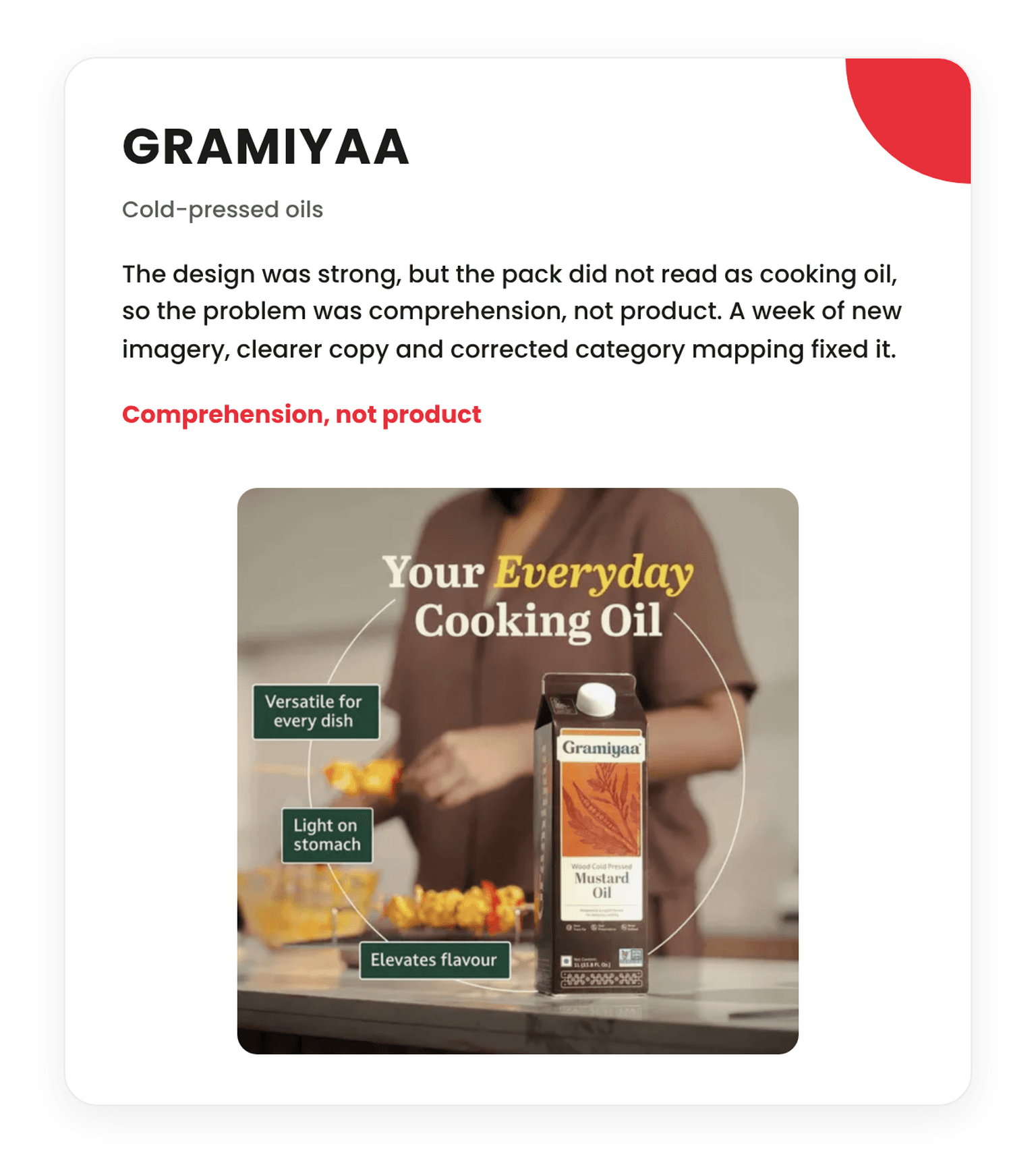
Platforms re-rank the app shelf continuously, so the work is a weekly loop: list, read sell-out, fix the page, read again. This loop runs every week online against quarterly on a physical shelf. Rank and retail media still cost real money, and promotions add to it, so budget for them as recurring expenses from launch.
Get the full report
Brands Beyond the Shelf sets out the data behind this guide: market sizing, online grocery leaders and the brand case studies. [Download the report]
3. Read your data more deeply
Go a layer deeper and compare each line’s rate of sale with how widely it is distributed. This tells you whether growth comes from consumer pull or from visibility. If your fastest sellers are your least distributed, you have real pull. If your most-distributed lines are your slowest, you are coasting on listings and mistaking it for growth. Let this reading decide where distribution follows.
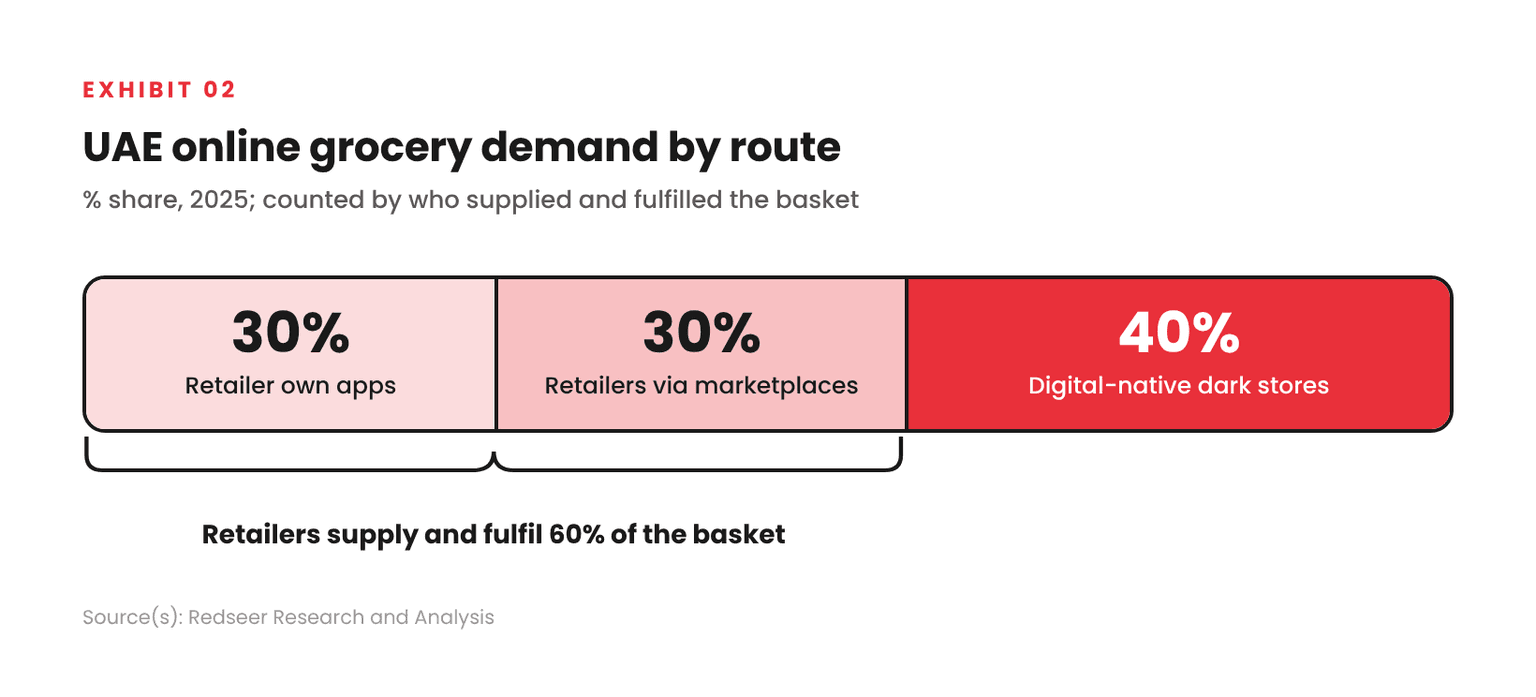
Understand the substitution logic on each app, because you can lose baskets there without noticing. Concentration is another risk. In the UAE, retailers’ own apps and marketplace sales each carry 30% of the online basket, and digital-native dark stores carry 40%, so no single route covers the market. If half of your revenue comes from one platform, you fund its growth while it holds the leverage.
Expect competition from the platforms too. Private labels already make up more than 25% of sales for large GCC retailers, and platforms are scaling their own product lines. Build something a platform cannot copy in ninety days.
4. Use online shelves to prove your product’s demand and price and physical one to scale
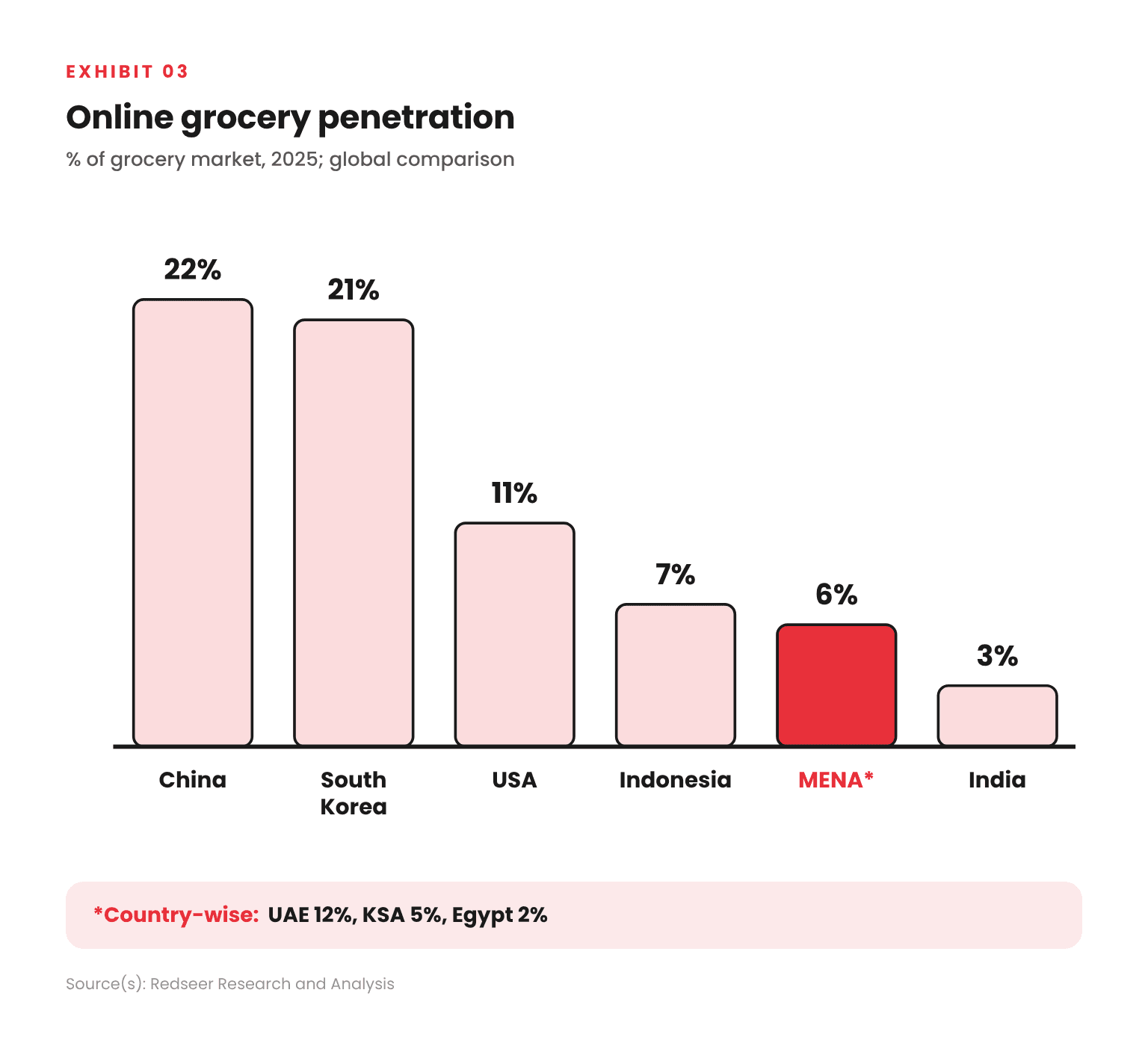
Everything above can be done online, but online grocery is about 6% of MENA grocery spend. Most sales still move through stores, so a meaningful share of the shopper’s wallet needs physical distribution.
Online data is what connects the two. We see brands increasingly winning physical shelf space with online proof such as rate of sale. Go to retail buyers about three to six months after launch with sell-out evidence. You can list faster this way, and on terms you can live with.
Plaay, the better-for-you chocolate brand, built its rate of sale on quick platforms such as Noon Minutes and Talabat, then converted it into listings at retailers including MAF Retail, Choithrams, and Spinneys.
Redseer believes that the expansion phase will not last. Convenience will carry a real price, wallet share will become the fight, and gains will concentrate among brands that defend them. As important as scaling online is, it will not replace the store, and brands should not plan as if it will. Distribution used to be the prerequisite for proof, but increasingly this order is getting reversed.
Redseer Advisory
- Prove before you distribute. Launch one product in one city, read sell-out weekly and scale or kill in days.
- Run the shelf weekly. Fix your pages, budget rank and retail media as recurring costs, and win the substitution logic.
- Test for pull. Compare each line’s rate of sale with its distribution; beware of concentration risks and platform dependency.
- Take the evidence to stores. Show buyers your sell-out data three to six months after launch to secure shelf space.
Written by



Brands Beyond the Shelf: MENA Consumer Brands’ New Growth Playbook
The Online Grocery Report 2026: The Five-Way Win and What Comes Next

Unlocking the Next Wave of MENA E-commerce Growth
UAE Online Grocery: Dark Stores Have the Momentum. Retailers Still Have the Market.
The Private Label Playbook is Moving from Retail Shelves to Dark Stores

The KSA Beauty Shelf Is Getting Crowded From Two Sides. Brand Equity Alone Won’t Hold It.

The Two-Hour Window: How Quick Delivery is Reshaping KSA’s Beauty Market

Value Retail: The Quiet Force Reshaping MENA’s Consumer Economy
Quick Retail Surges: Ninja Leads in KSA, Talabat and Noon Share the Lead in UAE
UAE’s Next Frontiers of Online Retail Growth

Q-Commerce 2.0: Why Quick Retail is the New Norm- Quick Retail to be a bigger opportunity than Food delivery

KSA Food Aggregators Leap Ahead in Growth Journey
Brands Beyond the Shelf: MENA Consumer Brands’ New Growth Playbook
The Online Grocery Report 2026: The Five-Way Win and What Comes Next
Unlocking the Next Wave of MENA E-commerce Growth
UAE Online Grocery: Dark Stores Have the Momentum. Retailers Still Have the Market.
The Private Label Playbook is Moving from Retail Shelves to Dark Stores
The KSA Beauty Shelf Is Getting Crowded From Two Sides. Brand Equity Alone Won’t Hold It.