The $11.5 Bn Basket: Where MENA Online Grocery Goes Next


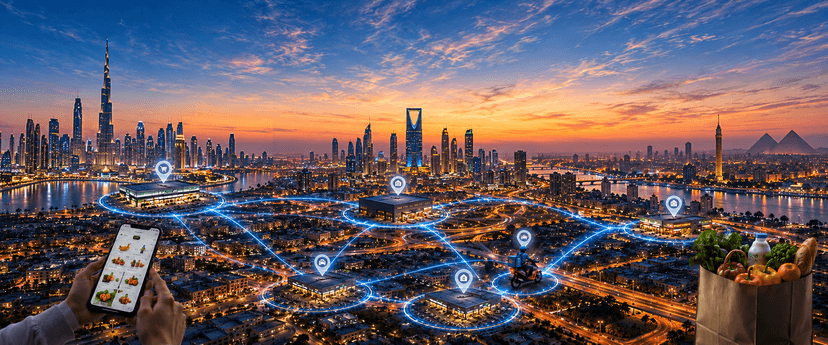
Food delivery built the first growth curve in the Gulf’s on-demand delivery market. Online grocery retail is building fast on top of it. We expect online grocery in the UAE, Saudi Arabia, and Egypt to nearly double, from $6 Bn in 2025 to $11.5 Bn by 2028, with Saudi Arabia overtaking the UAE as the larger market along the way.
The groundwork is already visible. The online grocery market in the UAE, Saudi Arabia and Egypt grew from $3.7 Bn in 2023 to $6 Bn in 2025, a 27% annual rate. This did not happen at the expense of offline stores. Offline grocery still grew from $95 Bn to $100 Bn over the same years. Shoppers are buying online alongside their regular grocery runs, which tells us the new channel is expanding the market rather than splitting it.
Three shifts sit behind this forecast. Saudi Arabia will bring the next wave of shoppers, quick retail will win a bigger share of their baskets, and platforms will have to turn that growth into real profit. We look at what each of these shifts means for platforms, retailers and brands.
1. Saudi Arabia will bring the next wave of shoppers
Today the UAE is the more developed market: online grocery makes up 12% of its grocery spend, against 5% in Saudi Arabia. This is not to say that the habit doesn’t exist in Saudi Arabia, because our survey shows that about two in three Saudi consumers bought groceries online in the past year. What holds Saudi Arabia back is supply. Store coverage, range and reliable delivery are the gaps, more than demand.
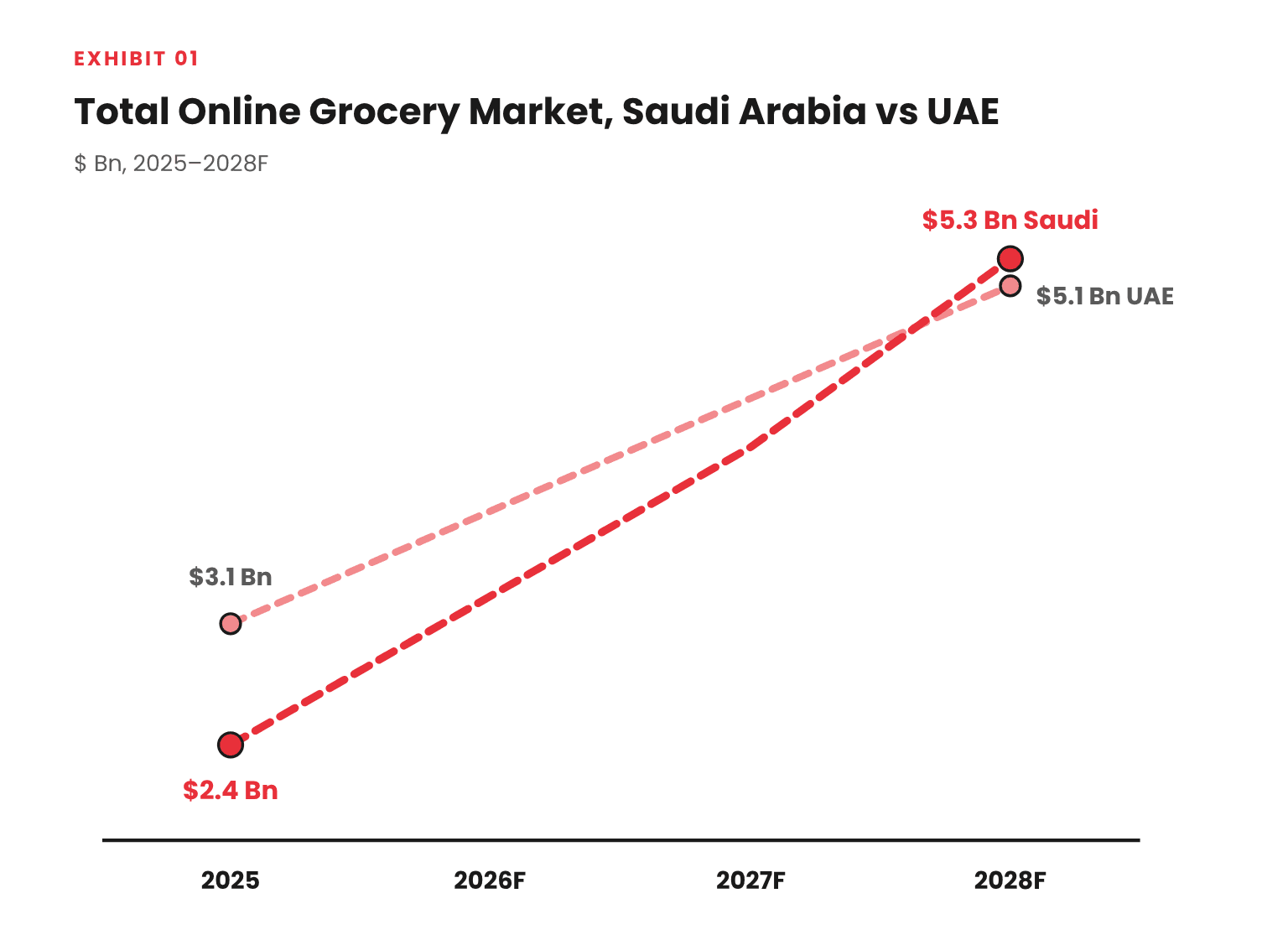
However, this gap is closing. Saudi Arabia produced 64% of the new quick-retail value across the GCC, and its quick retail grew 112%. If that pace holds, we forecast that Saudi online grocery will overtake the UAE by 2028, at $5.3 Bn against $5.1 Bn; in 2025 it stood at $2.4 Bn against $3.1 Bn. Saudi Arabia does not need UAE-level penetration to be the bigger market. As platforms improve coverage and reliability beyond big cities, scale will follow.
Meanwhile, the UAE grows more slowly, held back by stronger incumbents, settled shopping habits and rivals that arrived later. Quick retail in Egypt, Iraq and Jordan combined also grew by more than 100% in nine months, which suggests the pattern reaches beyond Saudi Arabia: growth in markets with thin supply follows when platforms invest.
2. Quick Retail will win a bigger share of the basket
Quick retail makes up only 36% of GCC delivery value, but it produced 55% of the growth in the first nine months of 2026. Speed is its biggest selling point at the current stage, but it will soon not be enough to keep shoppers.
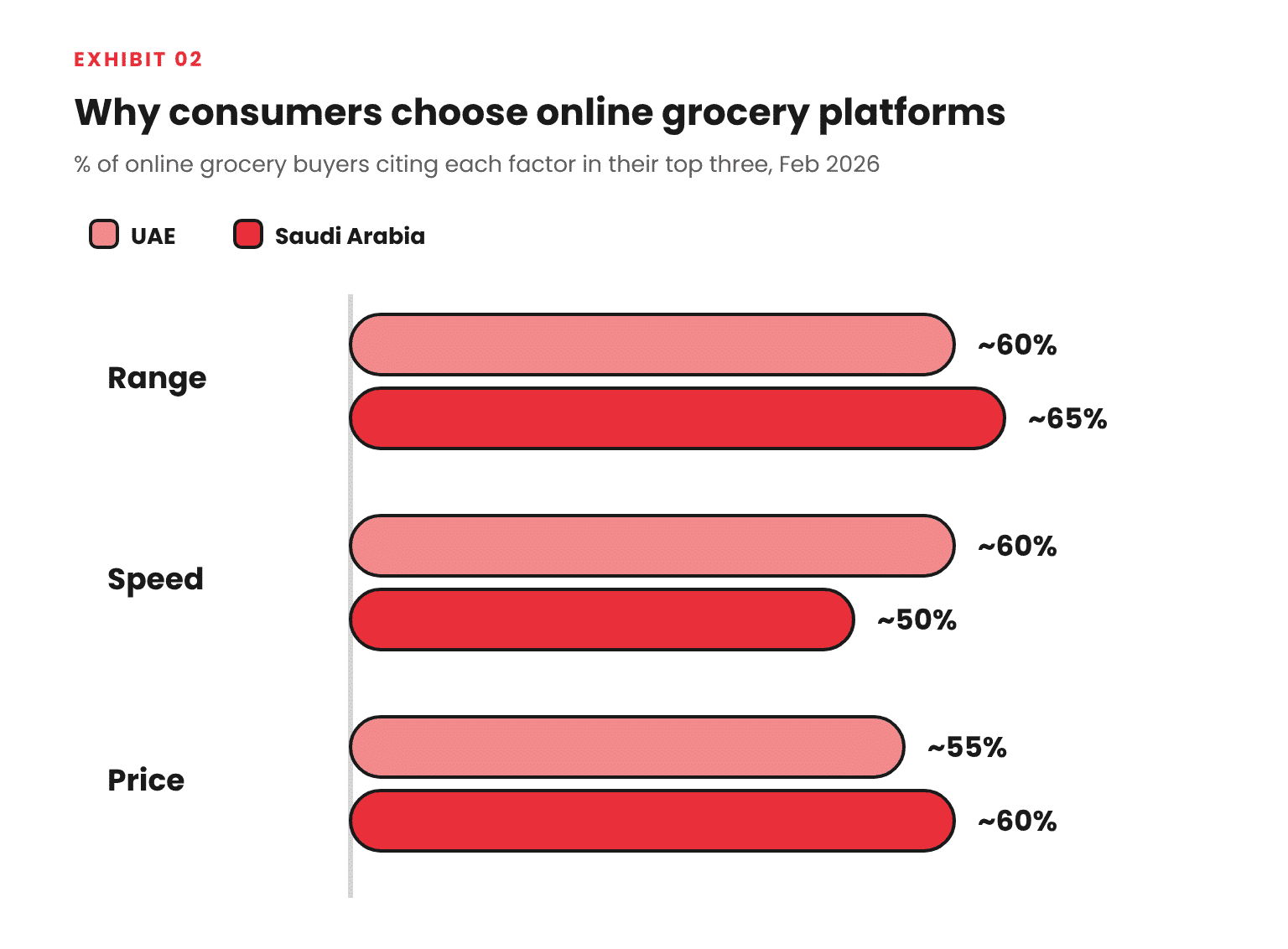
When we asked 500 UAE online grocery buyers in February 2026 why they pick a platform, about 60% named range and about 60% named speed, with price close behind at about 55%. Shoppers want all three at once, so a platform that wins on speed alone leaves room for rivals that match it on range and price.
For many platforms, grocery becomes the entry point for quick retail. In the UAE, 89% of quick-retail users buy it through the app, and it makes up about 70% of quick-retail value. Other categories like pharmacy and beauty also bring in customers and provide better margins, allowing platforms to pay for better range and prices on groceries.
Stores still hold one clear edge. Most grocery shopping is planned, built around a full basket and driven by fresh food, and that is where retailers bring their variety, their loyalty programmes and the trust shoppers place in their fresh produce. In our reading, quick grocery retail needs to match that to move beyond top-up-driven buying and capture weekly shopping baskets.
3. Profit decides who keeps the growth
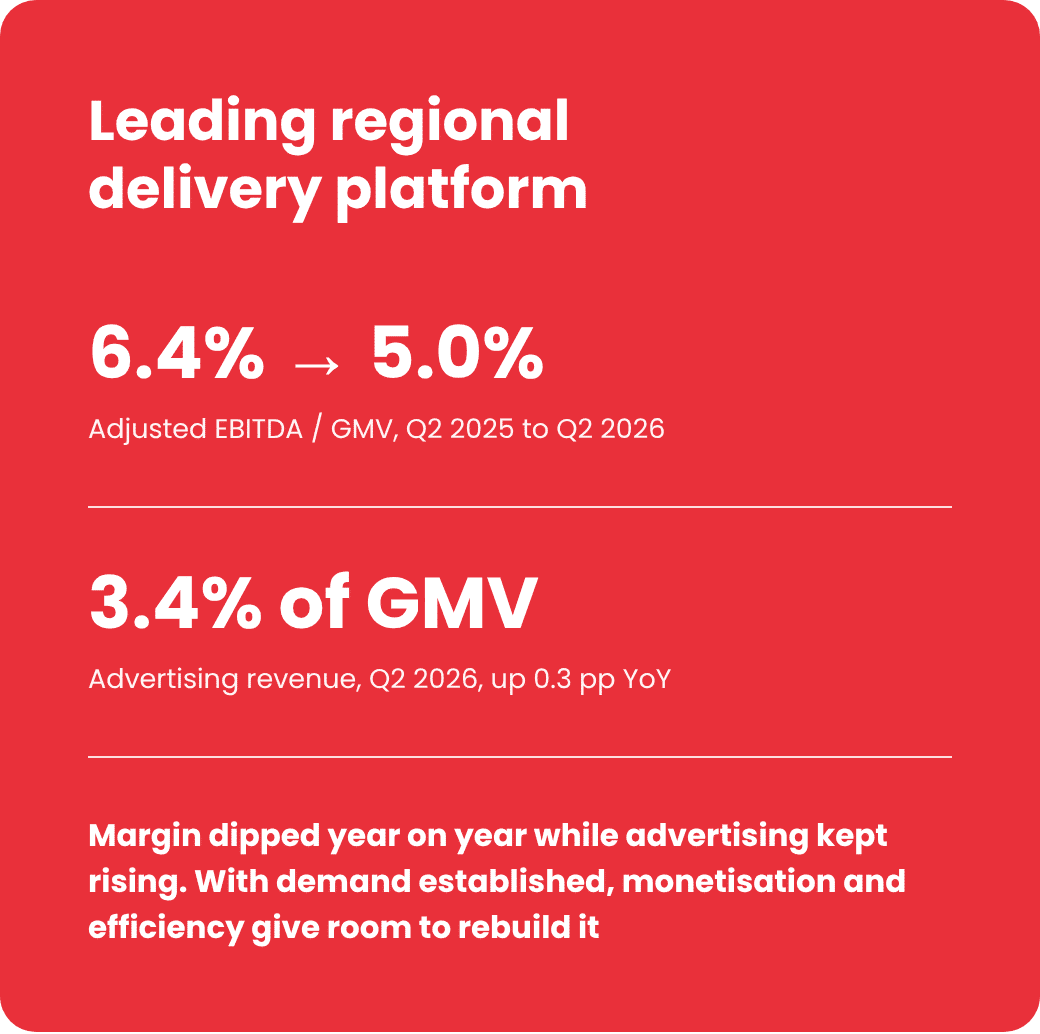
Now that demand is established, platforms must show they can make money from it, and Talabat shows the pressure. Between Q2 2025 and Q2 2026, its adjusted EBITDA fell from 6.4% to 5.0% of GMV. Advertising revenue reached 3.4% of GMV over the same year, and that income now equals about 70% of adjusted EBITDA, up from about 50%. Ads earn on orders the platform already delivers, so they add revenue without adding a trip.
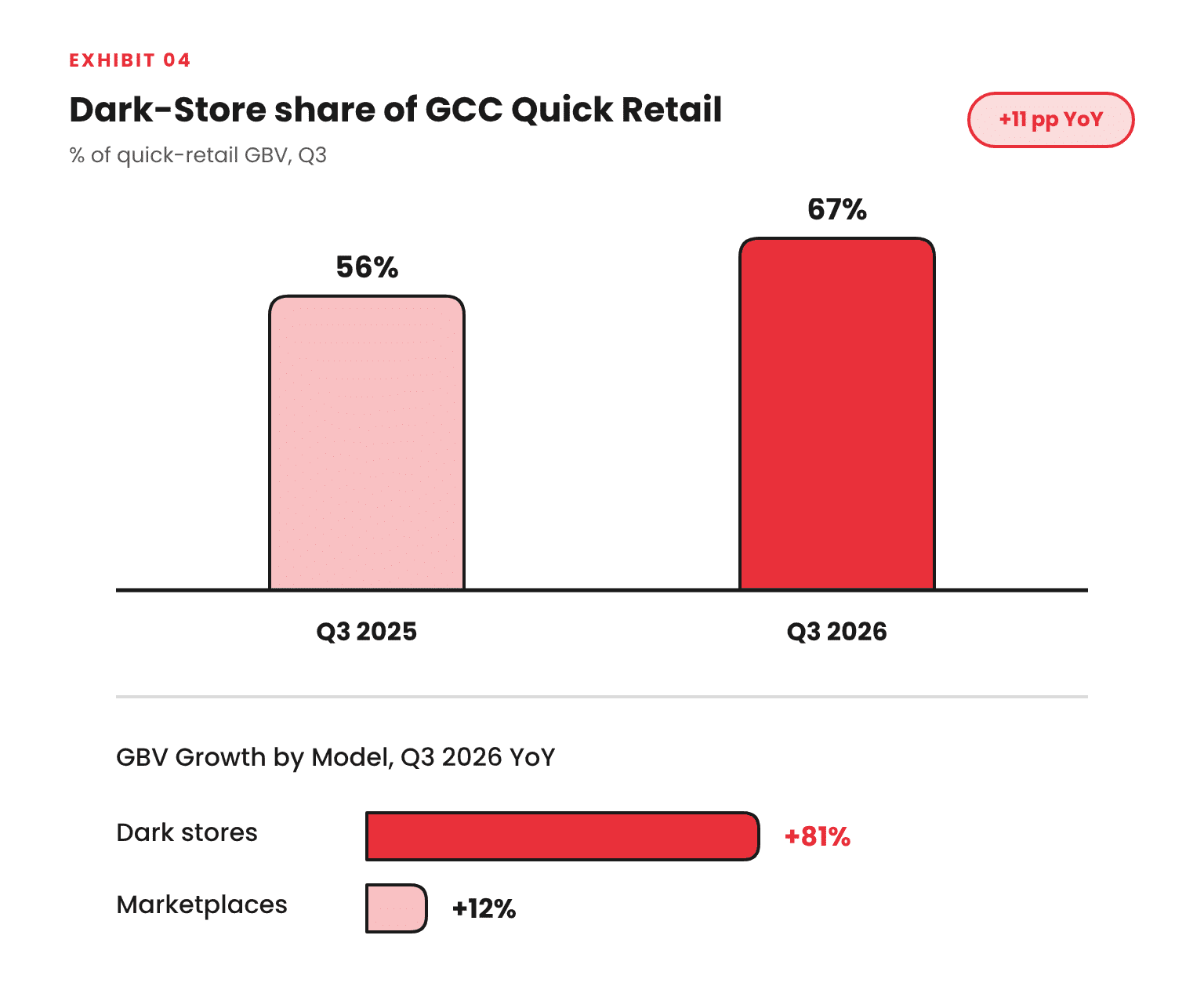
The quick retail ecosystem is increasingly being built with the dark store model. Its share of GCC quick-retail value rose from 56% to 67% in a year, and its sales grew 81%, against 12% for marketplaces. But a dark store carries the site, the stock and the labour to pick every order, so each one needs enough orders to pay for itself.
External pressure is building too. Kuwait caps merchant fees at 17%, ad and placement fees included; Dubai has set rules on transparency in fees, rankings and data; Saudi Arabia has issued conduct guidelines; and global groups are buying into regional delivery businesses. For the near term, we expect more growth spending, sharper pricing and heavier promotion. Over time, we expect the economics to favour a better balance of growth and profit.
Redseer believes Saudi Arabia will bring the next wave of shoppers, and a stronger range and price offer will move more of their weekly basket to quick retail. Two models will emerge side by side in UAE: dark stores driving 60% of online grocery in one path; retailers holding their lead in the other. Growth is now established, so the players that prove their economics first will keep their share when competition and regulation tighten.
Redseer Advisory
For Brands – Prove demand online first, then take the sales data to retail buyers and ask for a store listing. Avoid putting half your revenue on one platform. Build something a platform cannot copy in ninety days, since platforms are scaling their own product lines.
For Platforms – Prove that each dark store can pay for itself before you chase more share. Build advertising income alongside but plan for fee caps and new rules on transparency. Keep improving range and price too, the two things shoppers rank next to speed.
For Retailers – Fix your own app and fulfilment first. Then use several routes to the shopper, including your own app, platform storefronts, and supply deals with dark stores. Negotiate commission and data rights while your store network still gives you leverage and keep growing private labels to protect price and margin.
For Investors – Judge platforms on profit per order, not order growth alone, and give credit for income beyond delivery such as ads, subscriptions and fees. Value the players likely to survive consolidation, not the whole field.
Written by



How Quick Retail is Reshaping MENA

Brands Beyond the Shelf: MENA Consumer Brands’ New Growth Playbook
The Online Grocery Report 2026: The Five-Way Win and What Comes Next

KSA Food Delivery: Free Delivery Isn’t Free

Unlocking the Next Wave of MENA E-commerce Growth

GCC Q-commerce: Expansion & Consolidation

How We Crafted a Leading Saudi Food Aggregator’s Growth Strategy

The Guide to Launching an Online Retail Brand in MENA

UAE Online Grocery: Dark Stores Have the Momentum. Retailers Still Have the Market.

The Private Label Playbook is Moving from Retail Shelves to Dark Stores

Omnichannel Owns a Big Slice of Online Retail in KSA

The Two-Hour Window: How Quick Delivery is Reshaping KSA’s Beauty Market
How Quick Retail is Reshaping MENA
Brands Beyond the Shelf: MENA Consumer Brands’ New Growth Playbook
The Online Grocery Report 2026: The Five-Way Win and What Comes Next
KSA Food Delivery: Free Delivery Isn’t Free
Unlocking the Next Wave of MENA E-commerce Growth
GCC Q-commerce: Expansion & Consolidation