Who Owns the Customer When AI Owns the Answer?


Everyone is fighting for the transaction. The decision is being taken one step upstream, and most companies are not counting that score.
In the latest Voice of Customer study by Redseer Strategy Consultants across the UAE, Saudi Arabia and Egypt, one in three consumers now uses an AI platform – Claude, ChatGPT, Gemini, Grok – to discover their products/services. That is not a fringe habit maturing. It is a mainstream shift that formed faster than almost anything we have tracked in the region.
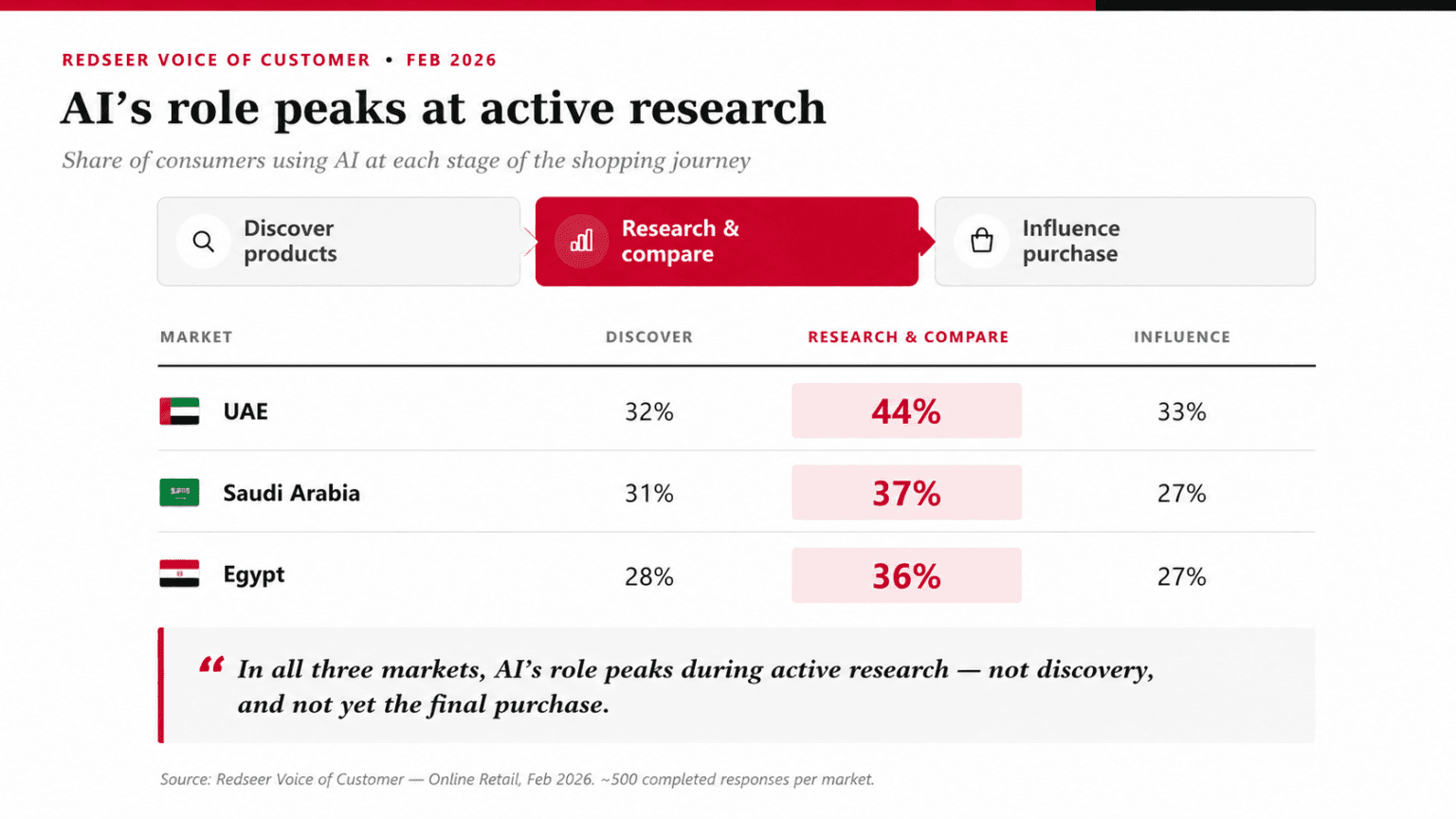
The useful question is not whether people shop with AI, but where in the journey does it sit. And the data is unusually clear: AI’s influence peaks not at checkout but at research and comparison; this is where AI shopping use concentrates: ~44% in the UAE, ~37% in Saudi Arabia, ~36% in Egypt, at present.
Today, the purchase recommendations AI provides, influences a user decision far beyond than anything else.
Not the biggest channel. The most trusted one.
By raw traffic, AI is not the largest channel, even today, social platforms, retailers and search still reach far more shoppers. But reach is the wrong scoreboard. Reach counts who passes through a channel; it says nothing about how much that channel moves their mind. When a shopper asks an assistant “which of these is actually worth it,” trust on the AI advice is far higher.
That is the whole game. A decade of commerce optimised for reach — impressions, rankings, visibility. AI rewards something reach cannot buy: being the answer when a customer asks what to do.
The stakes are concrete. Online retail across these markets is nearing ~$47 billion in 2026 and should exceed ~$60 billion by 2028. A rising share of that spend is decided — mentally, if not financially — before a shopper reaches any storefront. The transaction still lands in someone’s dashboard. The decision that produced it happens where the dashboard cannot see.
Value is moving to the decision, not the transaction
Commerce used to be vertically integrated: whoever owned the storefront owned the customers discovery, decision, payment, delivery, loyalty, all bundled behind one relationship.
That bundle is splitting, and AI has taken the two layers that matter the most ‘discovery and decision’, the points where preferences form and the choice set narrows to two or three names. By the time a “transaction” happens, the real decision is already over.
Here is the pattern worth remembering. In every prior unbundling of commerce, margin migrated to whoever controlled the decision, not whoever processed the order. Search engines that owned discovery taxed everyone downstream. Marketplaces that owned the shortlist turned brands into interchangeable supply. AI sits earlier than either and commands more trust than both.
The mild version has arrived. The disruptive one is next.
Today’s AI commerce looks incremental: it answers when asked, narrows the options, hands the shopper back to a familiar buy button. But the retailer no longer speaks to the customer directly. It feeds information to an intermediary that decides what is shown, how it is described, and what is left out. The shelf still exists with a gatekeeper in front of it, and the gatekeeper is the one the customer trusts. That is a big change disguised as a small one.
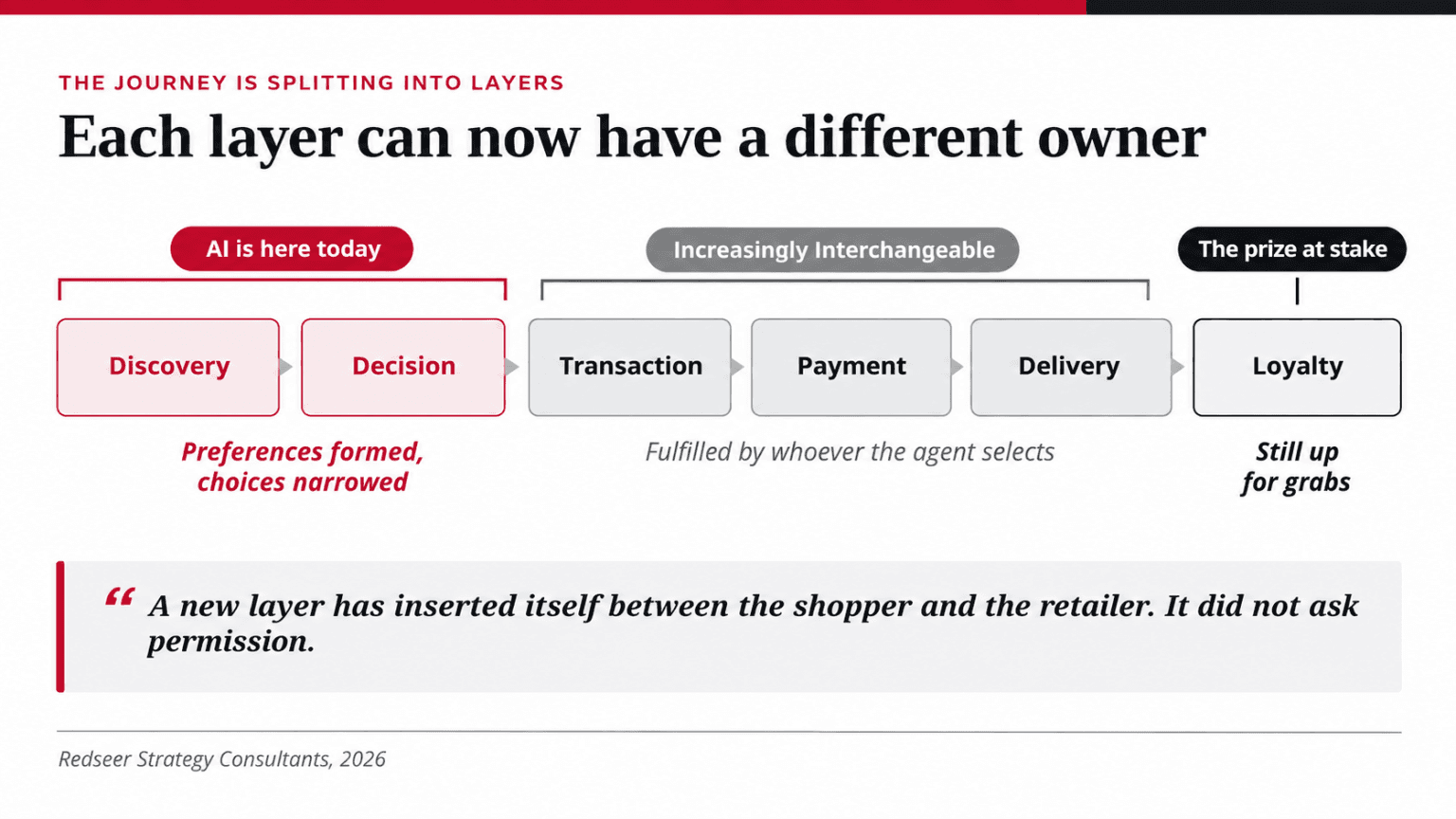
The agentic version drops the disguise. It will compare, check availability, choose a seller, pay, and reorder; until the shopper stops visiting the retailer at all. Orders keep arriving. Dashboards keep climbing. The relationship has already left the building.
GMV, order volume and app traffic show where the transaction happened. Not who shaped it, who holds the preference data, or who decides the next purchase. By the time those numbers turn, the customer will have been gone for years.
From searchable to answerable
For a decade, winning meant being searchable, but today, AI adds a harder test, being answerable. When a customer asks what to buy, three things decide whether a brand exists at all:
- Whether it appears in the answer
- Whether the information is accurate
- Whether it is recommended rather than a footnote
That is an operational discipline, not a marketing tweak. It means structuring product information for LLM’s as deliberately as it was once structured for search engines and retail buyers in this region, in both Arabic and English, and treating AI-referred traffic as a measured channel, not anonymous curiosity. Marketplaces face the same fork: build an assistant customers trust, or become the interchangeable supply behind someone else’s. Owning the answer is the new version of owning the shelf.
Five operating questions for leadership teams
- Will customers still choose us if an AI assistant controlled the shortlist?
- Do we know the customer, or only the order?
- Is our product information built for machines and humans?
- Is our loyalty programme building customer preference, or is it just funding transactions?
- Can we reach customers directly, or should we keep paying an intermediary for access?
Can the Winner Take it All
The next winners here may not be the companies that process the most orders. They will be the ones that stay closest to the customer while everything between discovery and delivery becomes interchangeable.
Everyone wants the order. It is the visible, measurable, satisfying thing to win. The more valuable prize sits upstream and largely uncontested: the right to meaningfully influence their next decision.
Written by



Brands Beyond the Shelf: MENA Consumer Brands’ New Growth Playbook

The Online Grocery Report 2026: The Five-Way Win and What Comes Next

Unlocking the Next Wave of MENA E-commerce Growth

UAE Online Grocery: Dark Stores Have the Momentum. Retailers Still Have the Market.

The Two-Hour Window: How Quick Delivery is Reshaping KSA’s Beauty Market

Omnichannel Owns a Big Slice of Online Retail in KSA

The KSA Beauty Shelf Is Getting Crowded From Two Sides. Brand Equity Alone Won’t Hold It.

Three Consumer Shifts Shaping MENA’s Demand Landscape in 2025

The Private Label Playbook is Moving from Retail Shelves to Dark Stores

UAE Ramadan 2026: Steady mood, sharper channel choices, and community-led influence

GCC’s Online Retail Market is Truly Democratic

UAE’s Next Frontiers of Online Retail Growth
Brands Beyond the Shelf: MENA Consumer Brands’ New Growth Playbook
The Online Grocery Report 2026: The Five-Way Win and What Comes Next
Unlocking the Next Wave of MENA E-commerce Growth
UAE Online Grocery: Dark Stores Have the Momentum. Retailers Still Have the Market.
The Two-Hour Window: How Quick Delivery is Reshaping KSA’s Beauty Market
Omnichannel Owns a Big Slice of Online Retail in KSA